Had a lot of fun this morning at GoDataFest.com with Anindita M. and Chozhan D M in a panel about the results of our Data & AI Monitor. We talked about data quality, responsible and ethical AI, sovereign cloud, and more.
Thanks to skills, you can reduce your multi-agent setup to a single agent with skills, greatly reducing complexity and increasing speed of execution.
In fact, if in the past you could have a number of agents each specialized in, for example, data analysis, getting data from a particular set of websites, making that data available in a dashboard, etc., with skills you can substitute all these agents with skills.
And skills are remarkably simple: just a markdown file with instructions, some (Python) scripts, and optional resources.
Can’t wait for all LLM providers to adapt their new pattern!
Come for the title, stay for the salacious questions like “how do elderly people have sex” (the answer given in the article is “with great difficulty and by taking risks").
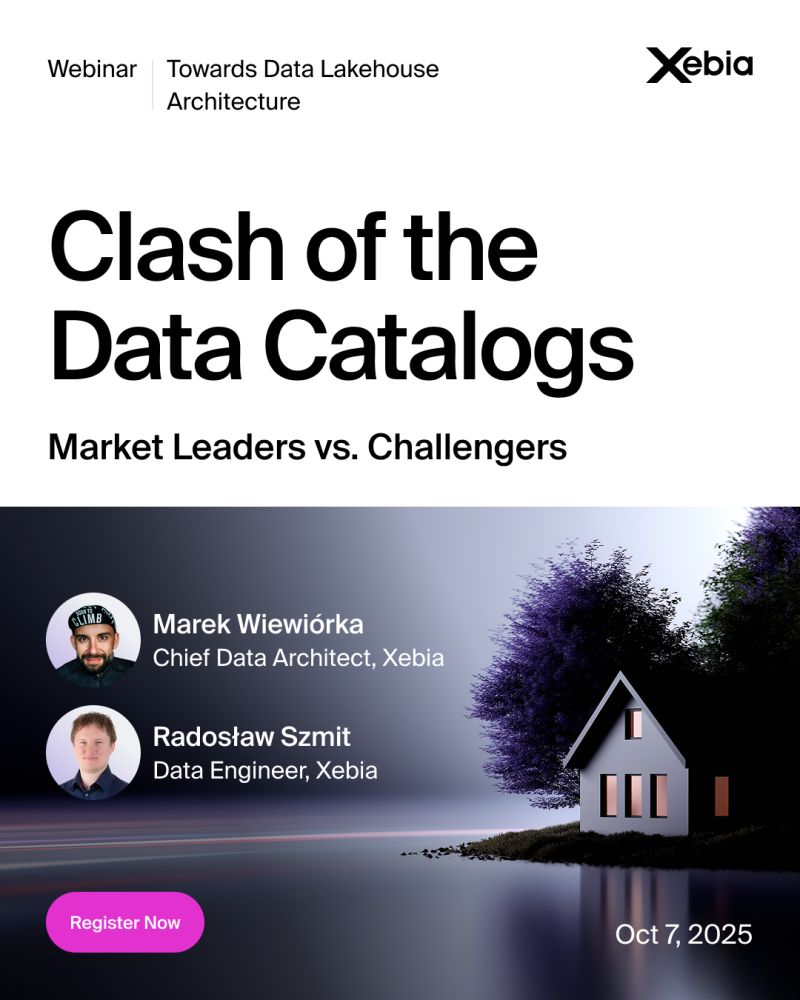
Data Lakehouse seems to be a new buzzword; everyone wants it, but do you really need it?
We’ve organized a webinar series to help you choose, and next week Marek Wiewiórka and Radosław Szmit will host the third episode to talk about data catalogs.
Among other things, they’ll cover:
Understanding key features of data catalogs
Exploring popular open-source solutions
How to improve data management through a well-set-up data catalog
Why do AI initiatives fail to deliver the value they promise?
Sandra Olsthoorn from the Dutch Financial Times (Het Financieele Dagblad) asked me this question and just published an article about it.
Organizations often skip the most important step when starting their AI journey: a solid AI strategy. Many know the adage, but few apply it: sharpen the axe before felling the tree.
What happens when you skip strategy? The data we collected for our Data & AI Monitor is clear:
Half of the respondents lacks a reliable and well-governed data foundation, leadership buy-in, and change management.
A third is unable to access data, lacks budget and technical know-how, and is unable to identify valuable use cases
The last point, identifying valuable use cases, is also a central piece of the article: often, organizations are looking for a big-bang use case in areas that are more directly linked to revenue (sales and marketing) and overlook the back office—where small improvements can have a tremendous effect on the bottom line!
The results? Only 24% of the organizations we surveyed believe they’re delivering real value!
Links in the comments!
Steven Nooijen Anand Sahay Mayank Verma Klaudia Wachnio (Zdunczyk) Xebia